


Work in Canada
Canada’s Job Vacancies Held Steady At 510,200 In Second Quarter 2026



Canadian job vacancies remained unchanged at 510,200 in the second quarter of 2026, according to Statistics Canada. Vacancies for roles requiring a high school diploma or less rose for the first time since 2022, while positions requiring a bachelor’s degree or higher fell 5.9% year over year, suggesting hiring demand is shifting toward trades and entry-level work.
How Many Job Vacancies Does Canada Have Right Now?
Statistics Canada’s second-quarter 2026 Job Vacancy and Wage Survey puts the national total at 510,200 open positions, essentially flat compared with the first quarter, which itself had seen a 2.7 percent increase. The national job vacancy rate, the share of all labour demand made up of unfilled positions, held at 2.8 percent, unchanged from both the previous quarter and the same period in 2025. There were 3.0 unemployed people for every vacant position nationally, down slightly from 3.1 a year earlier.
Total labour demand, which combines filled and vacant positions, rose 0.3 percent quarter over quarter and 1.0 percent year over year, driven mainly by payroll employment gains rather than a jump in openings themselves.
Which Skill Levels Are Seeing More Demand?
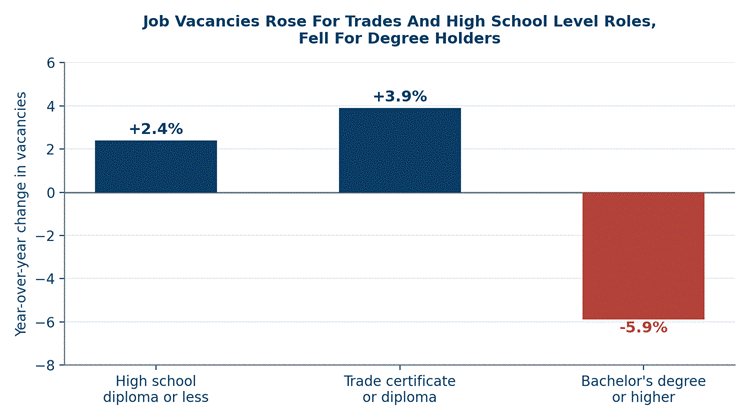
The most notable shift in this release is by education level. Vacancies for positions requiring a high school diploma or less rose by 7,000, or 2.4 percent, year over year, the first such increase since the third quarter of 2022. Vacancies requiring a trade certificate or diploma grew even faster, up 3.9 percent, and now carry the lowest unemployment-to-vacancy ratio of any education level, at 1.7 unemployed workers per vacancy.
Positions requiring a bachelor’s degree or higher moved in the opposite direction, falling 5.9 percent year over year. That group’s unemployment-to-vacancy ratio held steady at 4.9, nearly three times higher than the ratio for trades positions, a gap that points to a genuinely uneven labour market depending on the credential a worker holds.
Where Are Vacancies Growing Or Shrinking By Region?
Provincially, Newfoundland and Labrador posted the largest quarterly gain, up 700 positions or 14.9 percent. On a year-over-year basis, New Brunswick, Newfoundland and Labrador, and the Northwest Territories all saw vacancy increases, while Nunavut recorded a sharp 38.1 percent decline. At the regional level, Toronto added the most vacancies quarter over quarter, up 3,600, while Kitchener-Waterloo-Barrie and Kingston-Pembroke both saw declines.
By occupation, trades, transport and equipment operator roles led year-over-year growth at 98,600 vacancies, up 6.6 percent, driven largely by demand for material handlers, installers, and transport truck drivers. Natural and applied sciences occupations also grew for a second straight quarter, reaching 42,300 vacancies, with software developers and user support technicians among the fastest-growing roles. Education, law, social and government services occupations saw the steepest year-over-year decline, down 13.3 percent, alongside a 7.9 percent drop in health occupation vacancies.
What Does This Mean For Job Seekers And Newcomers?
For newcomers and prospective immigrants evaluating Canada’s labour market, this data carries a clear signal: demand is currently strongest for trades, transport, and other roles that don’t require a four-year degree, not for degree-dependent white-collar positions. That has direct relevance for anyone weighing which occupation or Express Entry category to pursue, given that several provincial programs and federal categories specifically target trades and in-demand occupations. Wage growth has also cooled noticeably, with the average offered hourly wage for vacant positions up just 2.0 percent year over year to $28.55, down from a peak of 7.6 percent growth in late 2024, worth factoring into any relocation or career decision based on expected earnings.