

Immigration Announcement
Canada Immigration Levels 2027-2029: Carney Signals a Possible Controlled Increase

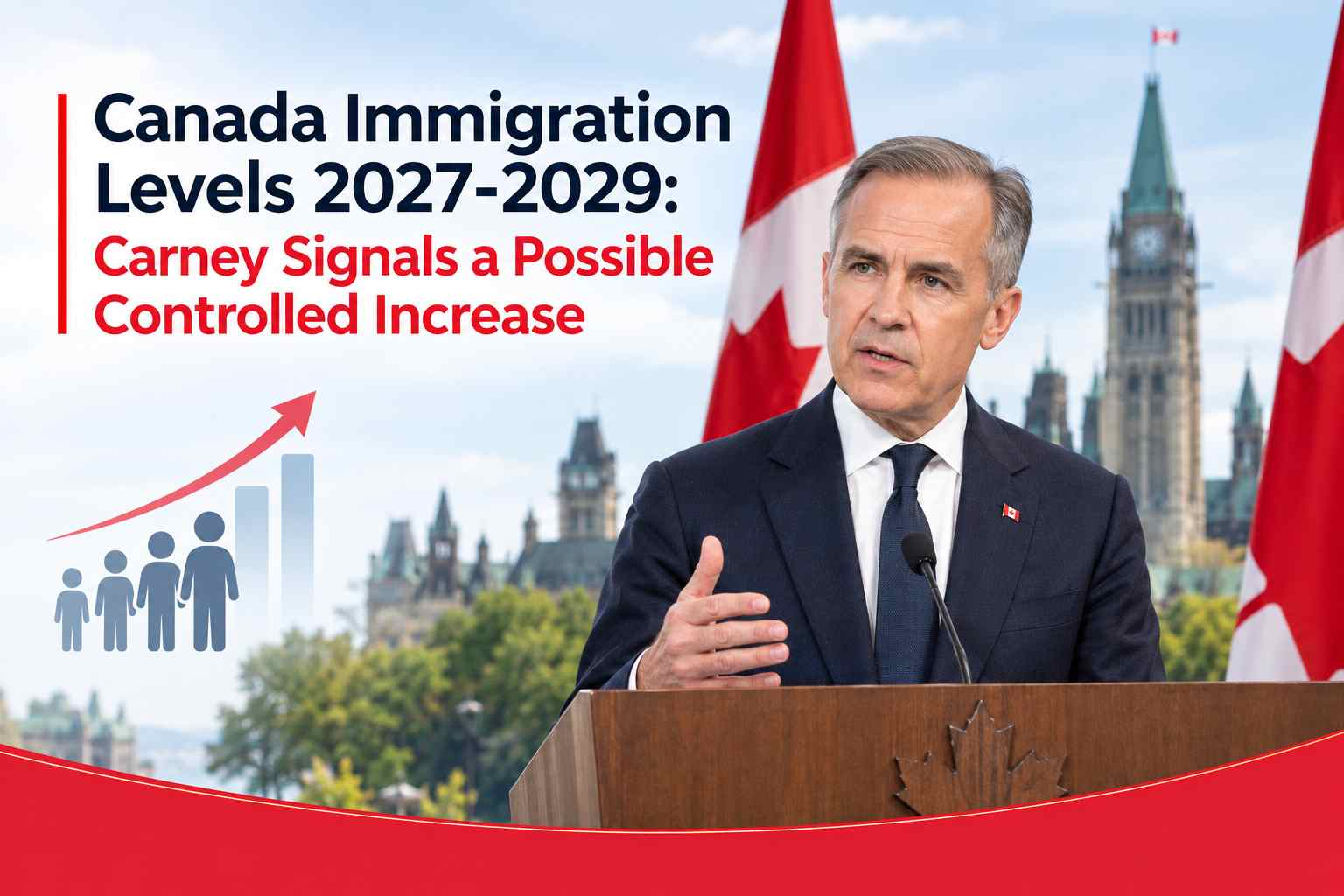

Prime Minister Mark Carney has signalled that Canada could eventually move toward higher population growth after a period of sharp reductions in temporary migration. His comments come as Ottawa prepares the next Canada immigration levels 2027-2029 plan, which is expected to establish the country’s immigration targets for the next three years.
The message from the government is not that immigration targets are increasing immediately. Rather, Carney has indicated that the next phase could involve a controlled increase if Ottawa remains confident that the immigration system is operating sustainably.
Carney Says A Controlled Increase Could Eventually Return
In a recent interview with The New York Times, Carney said the question is now when Canada should resume a “controlled increase” in population.
He argued that the government has brought the immigration system under control after a period of rapid growth.
The comments are significant because they suggest that the government’s immigration strategy could eventually shift from reducing population growth to managing a more moderate increase.
However, no new immigration targets have been announced as part of the comments.
Canada’s Immigration System Has Already Changed Sharply
Ottawa has spent the past two years reducing temporary resident arrivals.
The current 2026-2028 Immigration Levels Plan targets:
- 385,000 new temporary residents in 2026
- 370,000 in 2027
- 370,000 in 2028
The temporary resident targets include new international students and temporary workers.
Permanent resident admissions are set at 380,000 annually from 2026 through 2028.
The government has also committed to reducing the temporary resident population to below 5% of Canada’s total population by the end of 2027.
International Student and Worker Arrivals Have Fallen
Carney pointed to substantial reductions in several immigration flows.
The federal government has already reported that temporary resident arrivals declined significantly compared with earlier levels.
IRCC’s 2026 departmental plan says the target for new temporary residents was reduced from 673,650 in 2025 to 385,000 in 2026. The 2026 target includes 155,000 international students and 230,000 temporary workers.
These changes followed measures including tighter international student policies and restrictions affecting temporary worker programs.
What Would a “Controlled Increase” Actually Mean?
The phrase is important because it does not necessarily mean a return to the exceptionally rapid population growth seen during the post-pandemic period.
A controlled increase could involve a gradual adjustment to immigration targets based on:
- Housing supply
- Labour-market conditions
- Healthcare capacity
- Infrastructure
- Provincial needs
- Temporary resident numbers
- Canada’s economic growth
The current federal approach already emphasizes sustainability rather than simply maximizing immigration volumes.
The 2027-2029 Immigration Levels Plan Will Be the Key Test
Carney’s comments come shortly before the next immigration plan is due.
The federal government is legally required to table the next three-year Immigration Levels Plan in the fall of 2026.
That plan will provide the clearest indication of whether the government intends to maintain current levels, reduce them further or begin increasing admissions.
Until those targets are formally announced, prospective immigrants should not treat political comments about future increases as a new immigration program.
Could Presidence Targets Increase?
It is possible that the government could reconsider permanent resident targets in the future, but there has been no formal announcement that the current 380,000 annual target will be increased.
The current plan keeps permanent resident admissions stable at 380,000 in 2026, 2027 and 2028.
At the same time, the economic immigration share is increasing.
The federal government expects economic immigration to account for 64% of permanent resident admissions by 2027.
That could matter for skilled workers because future immigration planning may continue to favour candidates who match labour-market priorities.
What Could Change for International Students?
A controlled increase does not necessarily mean a return to the earlier international student intake levels.
The federal government has specifically reduced student arrivals as part of its effort to manage the temporary resident population.
The current 2026-2028 plan sets student arrival targets at:
- 155,000 in 2026
- 150,000 in 2027
- 150,000 in 2028
These are targets for new arrivals, not the total number of international students already living in Canada.
Therefore, prospective students should continue to consider study permit caps, provincial allocations and institutional requirements rather than assuming that future population growth will automatically expand study opportunities.
What About Temporary Foreign Workers?
The same distinction applies to workers.
The current plan targets 230,000 temporary worker arrivals in 2026 and 220,000 in each of 2027 and 2028.
The government is also attempting to transition some workers already in Canada to permanent residence.
A one-time initiative is designed to accelerate the transition of up to 33,000 skilled temporary workers to permanent residence in 2026 and 2027.
This suggests that future policy may put more emphasis on people who already have Canadian work experience and established ties.
Population Growth Versus Immigration Growth
It is also important to separate population growth from immigration levels.
A population can increase even when immigration admissions decline because population change includes multiple demographic components.
Conversely, high immigration does not automatically translate into the same level of population growth if departures increase.
Statistics Canada’s recent revisions illustrate why policymakers need to look at the entire demographic picture rather than a single immigration number.
What Should Immigration Applicants Watch Now?
For people planning to immigrate to Canada, the next several months could be particularly important.
Watch for:
- The 2027-2029 Immigration Levels Plan
- Express Entry category priorities
- Provincial nominee allocations
- Temporary resident targets
- International student policy changes
- New permanent residence pathways
- Sector-specific immigration initiatives
Applicants should base their plans on programs that are currently open rather than potential future increases.
The emerging Canada immigration levels 2027-2029 debate could mark a turning point in federal immigration policy.
After reducing temporary resident arrivals and stabilizing permanent resident admissions, the government is now discussing whether Canada can eventually resume a controlled increase in population.
Prime Minister Carney’s comments do not establish new immigration targets. The decisive information will come when Ottawa releases the next Immigration Levels Plan.
For applicants, the best strategy is to monitor official announcements while preparing for existing pathways rather than waiting for a possible future increase.
For the latest Canadian immigration policy developments, follow Canada Immigration News.
Frequently Asked Questions
Will Canada increase immigration in 2027?
A possible controlled increase has been discussed, but no new 2027 immigration target has been announced yet.
What are Canada’s current permanent resident targets?
The current 2026-2028 plan sets annual permanent resident admissions at 380,000.
What is Canada’s temporary resident target for 2027?
The current plan sets a notional target of 370,000 new temporary residents for 2027.
Why is Canada reducing temporary residents?
The federal government wants to reduce pressure on housing, infrastructure and services and bring the temporary resident population below 5% of the total population by the end of 2027.
When will Canada announce the 2027-2029 Immigration Levels Plan?
The government is expected to table the next three-year plan in fall 2026.