
Latest News
IRCC Ends New Referrals Under BVOR Refugee Program

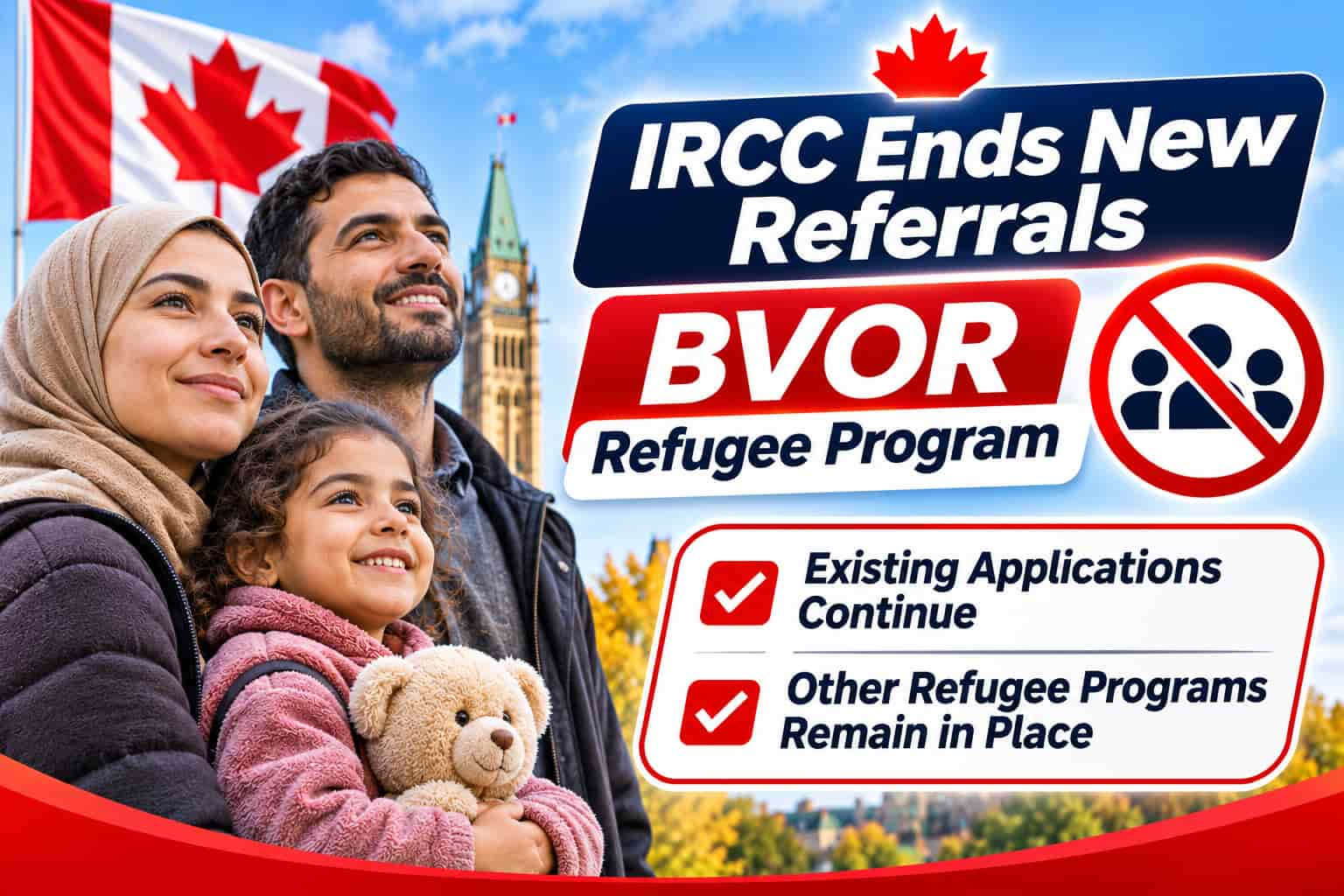

Immigration, Refugees and Citizenship Canada (IRCC) has stopped accepting new referrals under the Blended Visa Office-Referred (BVOR) Program, marking a change to one of Canada’s refugee resettlement pathways. The change took effect on November 20, 2026.
IRCC has confirmed that applications already received will continue to be processed. Refugees who have already been matched with sponsors will also be able to arrive in Canada and receive support as planned. The announcement does not mean that Canada has ended refugee resettlement or private refugee sponsorship.
Other established programs, including the Government-Assisted Refugees (GAR) Program and Private Sponsorship of Refugees (PSR) Program, remain part of Canada’s resettlement framework.
What Has Changed Under the BVOR Program?
The immediate change concerns the acceptance of new referrals.
| Program activity | Status |
|---|---|
| New referrals | No longer accepted |
| Applications already received | Processing continues |
| Refugees already matched with sponsors | Arrivals and support continue as planned |
| Government-Assisted Refugees Program | Continues |
| Private Sponsorship of Refugees Program | Continues |
The distinction between new referrals and existing applications is important. People whose applications are already in the system are not automatically affected in the same way as prospective new referrals. IRCC has indicated that previously arranged sponsorship support will continue according to existing plans.
Check Official Blended Visa Office-Referred (BVOR) Program Update Here
How Did the BVOR Program Work?
The Blended Visa Office-Referred Program combined government support with private sponsorship. Under the program, refugees identified through the applicable referral process could be matched with eligible private sponsors in Canada.
Financial support was shared between the federal government and sponsors. The government generally provided six months of financial assistance, while private sponsors covered the remaining six months.
Sponsors also helped refugees settle into Canadian communities by providing practical support during their first year. This could include assistance with finding housing, accessing services, understanding local systems and establishing community connections.
The blended approach was intended to combine public funding with the involvement of Canadian communities.
Why Is the Referral Change Significant?
The Program offered a distinct model of refugee resettlement because it involved both government funding and private sponsor participation. Ending new referrals limits the availability of that particular arrangement for future cases.
However, the change should not be confused with the closure of every refugee sponsorship option. Canada continues to operate other resettlement pathways, subject to their respective requirements and intake rules. For sponsors who had planned to participate in BVOR, the announcement means they will need to monitor the status of other available sponsorship programs. Existing sponsorship commitments should continue according to IRCC’s instructions.
Canada Will Continue Government Assisted Refugee Resettlement
The Government-Assisted Refugees Program supports eligible refugees referred for resettlement through recognized processes. Government-assisted refugees generally receive financial and settlement support funded by the federal government.
The program is distinct from private sponsorship, although both contribute to Canada’s refugee resettlement commitments. The continuation of GAR means that the end of new BVOR referrals does not eliminate government-supported refugee resettlement.
Private Refugee Sponsorship Also Continues
Canada’s Private Sponsorship of Refugees Program allows eligible sponsors to support refugees who qualify for resettlement. Sponsors undertake financial and settlement responsibilities according to program requirements. Private sponsorship has long been part of Canada’s refugee protection framework.
However, intake limits, eligibility conditions and processing rules may affect when and how sponsorship applications can be submitted. Prospective sponsors should therefore check current IRCC instructions before preparing an application.
Canada’s Refugee Targets for 2027 to 2029
The federal Immigration Levels Plan maintains an annual target of 49,300 admissions for refugees and protected persons from 2027 through 2029. Of this total, 29,300 admissions are planned under refugee resettlement categories. These figures demonstrate that refugee protection remains part of Canada’s immigration framework despite changes to individual programs.
The targets also distinguish refugee resettlement from other refugee and protected person admissions. Not every person included in the broader 49,300 target will arrive through an overseas refugee resettlement program.
What Happens to Existing BVOR Applications?
IRCC has stated that applications already received will continue through processing. Refugees who were previously matched with sponsors are expected to arrive in Canada and receive the planned support.
This provides continuity for existing arrangements, although individual processing timelines may still vary. Applicants and sponsors should continue following official instructions and monitor any communications concerning their cases.
Canada Maintains Refugee Protection Commitments
The decision to stop accepting new BVOR referrals represents a change to one specific refugee resettlement mechanism. It does not end Canada’s wider refugee protection system or eliminate all private sponsorship opportunities.
The continuation of existing applications and other resettlement programs remains important for refugees, sponsors and settlement organizations.
Follow Canada Immigration News for updates on IRCC refugee programs, sponsorship rules, asylum policies and Canada’s refugee admission targets.**
Frequently Asked Questions
Has Canada closed the BVOR Program?
IRCC stopped accepting new referrals as of November 20, 2026. Existing applications and previously arranged sponsorships will continue.
What does BVOR stand for?
BVOR stands for Blended Visa Office-Referred Program, a refugee resettlement pathway that shared support responsibilities between the federal government and private sponsors.
Will refugees already matched with sponsors still arrive?
Yes. IRCC has stated that previously matched refugees will continue arriving and receiving support as planned.
Can Canadians still privately sponsor refugees?
The Private Sponsorship of Refugees Program continues, subject to its applicable eligibility and intake requirements.
How many refugees does Canada plan to admit annually?
The 2027 to 2029 Immigration Levels Plan sets an annual target of 49,300 refugees and protected persons, including 29,300 refugee resettlement admissions.