

Immigration Announcement
Canada Raises Wage Thresholds for The Temporary Foreign Worker Program



Employers planning to hire temporary foreign workers have a new number to watch. Employment and Social Development Canada has updated the hourly wage thresholds used to sort Labour Market Impact Assessment applications into the high wage or low wage stream, effective for applications received on or after July 17, 2026. The change touches every province and territory and carries real consequences for how employers structure job offers.
What Actually Changed
Under the updated figures, Ontario’s threshold rises to $36.92 an hour, Alberta moves to $37.50, and British Columbia climbs to $38.40. Every jurisdiction across the country has been recalculated using the same method, the provincial or territorial median hourly wage from the Statistics Canada Labour Force Survey, plus twenty percent.
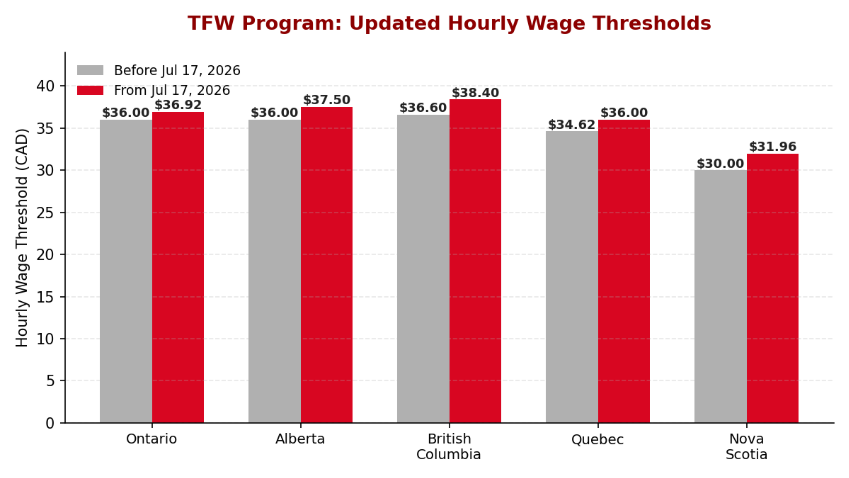
Figure 1: Updated hourly wage thresholds before and after July 17, 2026 across five major provinces.
Full Threshold Table
| Province / Territory | Before Jul 17, 2026 | From Jul 17, 2026 |
| Alberta | $36.00 | $37.50 |
| British Columbia | $36.60 | $38.40 |
| Manitoba | $30.16 | $31.33 |
| New Brunswick | $30.00 | $31.73 |
| Newfoundland and Labrador | $32.40 | $33.60 |
| Northwest Territories | $48.00 | $48.00 |
| Nova Scotia | $30.00 | $31.96 |
| Nunavut | $42.00 | $45.00 |
| Ontario | $36.00 | $36.92 |
| Prince Edward Island | $30.00 | $31.20 |
| Quebec | $34.62 | $36.00 |
| Saskatchewan | $33.60 | $34.62 |
| Yukon | $44.40 | $45.60 |
Why This Number Matters So Much
The wage threshold is not just a bureaucratic figure. It is the dividing line that determines which set of program rules an employer must follow. Offer a wage at or above the threshold, and the position falls under the high wage stream. Offer below it, and the low wage stream applies instead, complete with its own caps, requirements, and processing conditions. Getting the classification wrong, or worse, adjusting an offered wage specifically to land in a preferred stream, can lead directly to a negative decision on the Labour Market Impact Assessment.
It is worth separating the two terms that often get confused. The wage threshold is the government-set reference point for a province or territory. The offered wage is what an individual employer is actually proposing to pay for a specific role. Employers compare their own offered wage against the threshold to figure out which stream applies to them, but the offered wage also has to independently match the prevailing wage paid to Canadians and permanent residents doing similar work in the same location and with comparable experience.
What Employers Should Do Now
Any employer with a Labour Market Impact Assessment application in progress, or one being prepared for submission after July 17, needs to revisit their wage offer against the new figures. Simply inflating a wage to slip into the high wage stream, or trimming it to stay under the low wage threshold, is explicitly discouraged by the program and can undermine an otherwise strong application. The safer approach is to benchmark the position properly, confirm the applicable threshold for the province or territory in question, and ensure the offered wage genuinely reflects market rates for that role.
The Bigger Picture For Workers
For temporary foreign workers themselves, rising thresholds generally track cost of living and wage growth across the country, which is a positive signal. It means the wages employers must offer to qualify under these programs are keeping pace with what Canadian workers earn in comparable roles, reinforcing the principle that temporary foreign workers should be paid on par with their Canadian counterparts, not used as a way to undercut local wages.
Frequently Asked Questions
When do the new wage thresholds take effect?
The updated thresholds apply to Labour Market Impact Assessment applications received on or after July 17, 2026.
What is the difference between the wage threshold and the offered wage?
The threshold is the government benchmark for a province or territory, while the offered wage is the specific pay rate an employer proposes for a given position.
Can an employer simply raise the offered wage to qualify for the high wage stream?
Not safely. Wages must reflect the genuine prevailing rate for the role, and adjusting pay solely to fit a stream can result in a negative Labour Market Impact Assessment decision.
Which provinces saw the largest increases?
British Columbia and Nunavut saw some of the largest dollar increases, while several provinces, including Alberta, Ontario, and Quebec, also moved up meaningfully.
Where do these threshold figures come from?
They are calculated from the Statistics Canada Labour Force Survey median hourly wage for each province or territory, plus twenty percent.
Wage thresholds shift regularly, and missing an update can cost employers time and workers opportunities. Canada Immigration News covers every Labour Market Impact Assessment and Temporary Foreign Worker Program change as it happens, keeping you informed and ready for whatever comes next in your journey.