


Immigration Announcement
Chinese Communities in Canada Show Strong Growth, Diversity, and Socioeconomic Impact


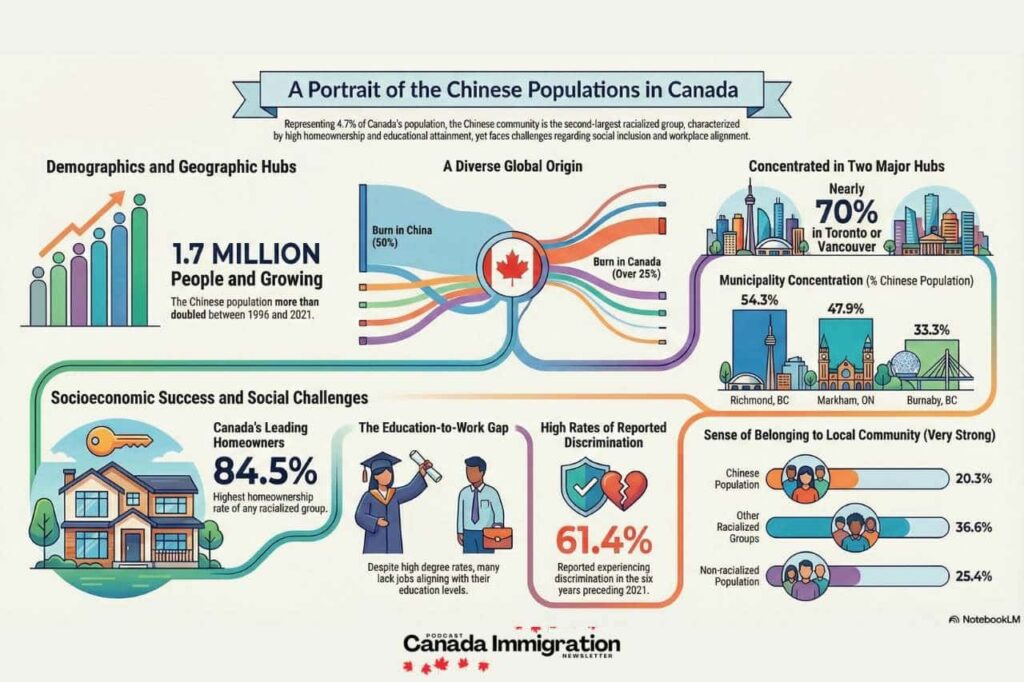
A new Statistics Canada report highlights the significant growth and diversity of Chinese communities across Canada, revealing that the population has doubled between 1996 and 2021, reaching approximately 1.7 million people, or 4.7% of the national population. Projections indicate continued growth, with the population expected to reach between 2.6 million and 3.5 million by 2041, further strengthening the community’s demographic and economic influence.
Chinese Canadians represent one of the country’s most diverse immigrant-origin communities, with varied migration histories, cultural backgrounds, and socioeconomic experiences shaping their contributions to Canadian society.
Table of Contents
Diverse Immigration Patterns and Settlement Trends
The report notes that 47.8% of Chinese Canadians were born in mainland China, while 28.4% were born in Canada. Others trace origins to Hong Kong, Taiwan, and Southeast Asia, reflecting multiple migration waves over several decades. Nearly all Chinese Canadians reside in urban areas, with large concentrations in the metropolitan regions of Toronto and Vancouver, where the community plays a major role in business, technology, education, and entrepreneurship.
This geographic concentration has contributed to vibrant cultural and economic networks that support entrepreneurship, trade connections, and innovation across industries.
High Educational Attainment and Workforce Contributions
One of the most notable findings is the community’s strong educational performance. More than 60% of Chinese Canadians aged 25 to 54 hold a bachelor’s degree or higher, significantly above the national average. This high educational attainment has helped drive participation in sectors such as engineering, finance, healthcare, research, and information technology.
Chinese entrepreneurs and professionals have also contributed to Canada’s global economic connectivity by supporting cross-border trade, research partnerships, and technology innovation.
Challenges Remain Despite Strong Educational Outcomes
Despite high levels of education, the report highlights persistent challenges, including higher unemployment rates compared with the non-racialized population and barriers related to credential recognition and employment matching. Many highly educated individuals remain underemployed relative to their qualifications, pointing to ongoing structural challenges in labour market integration.
The study also reports that more than 60% of respondents experienced discrimination between 2015 and 2020, underscoring the importance of inclusive policies, anti-discrimination initiatives, and workforce integration programs.
Policy Implications and Long-Term Outlook
Statistics Canada notes that understanding the diversity and experiences of Chinese communities is essential for shaping inclusive labour, education, and social policies. Programs supporting credential recognition, employment mobility, and anti-discrimination initiatives may help unlock the full economic potential of highly skilled immigrant populations. The continued growth and diversity of Chinese communities highlight their vital role in Canada’s demographic and economic future. While educational achievement and entrepreneurship remain key strengths, addressing labour market integration challenges will be essential to maximizing long-term contributions.