

Work in Canada
Canada Invites 6,986 Candidates in Latest IEC Draws


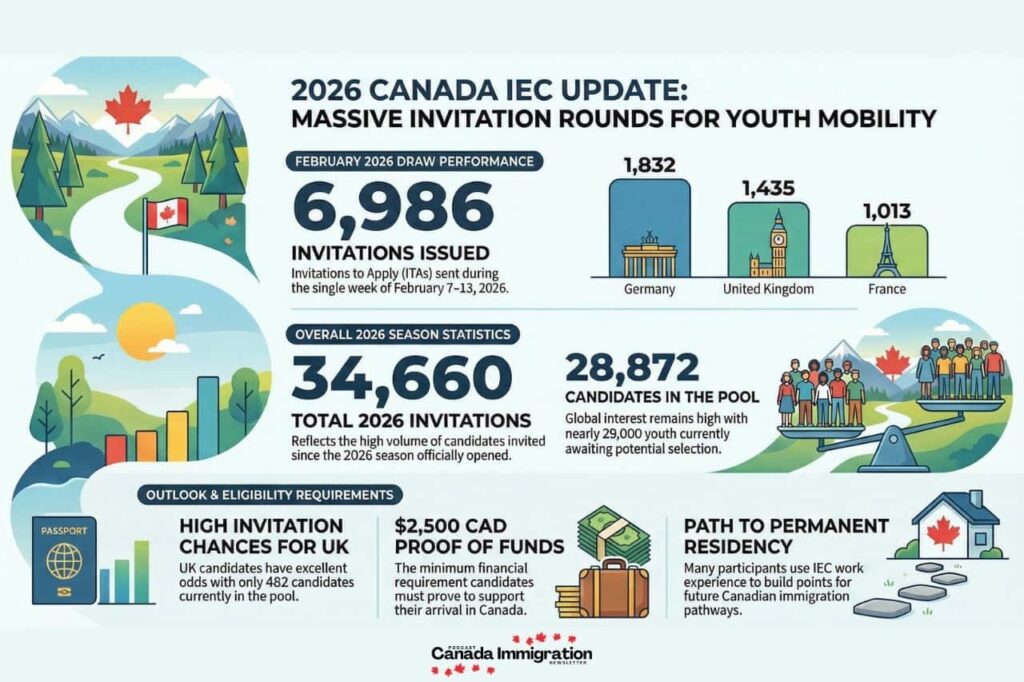
Canada continues to attract young global talent through the International Experience Canada program, with Immigration, Refugees and Citizenship Canada issuing 6,986 Invitations to Apply during draws held between February 7 and February 13, 2026. The latest rounds highlight strong participation across multiple countries and reinforce Canada’s position as a leading destination for youth mobility and cultural exchange.
Table of Contents
IEC Program Remains Highly Active in 2026
The International Experience Canada program allows young people from partner countries to work and travel in Canada through open work permits, usually under the Working Holiday category. The initiative supports labour market needs while promoting cultural exchange and international experience.
As of February 13, 28,872 candidates remained in the pool awaiting invitations, demonstrating continued global interest in the program. With the 2026 season officially underway, Canada has already invited 34,660 candidates this year.
Breakdown of Invitations by Country
The latest rounds covered a wide range of participating countries. Key invitation numbers included:
- United Kingdom – 1,435 ITAs
- Germany – 1,832 ITAs
- France – 1,013 ITAs
- Korea – 470 ITAs
- Taiwan – 371 ITAs
- Ireland – 279 ITAs
- Spain – 258 ITAs
- Portugal – 231 ITAs
Other countries receiving invitations included Australia, Belgium, Chile, Italy, Sweden, Switzerland, and more, reflecting the global reach of the IEC program.
United Kingdom Pool Shows Strong Opportunities
The United Kingdom remains one of the largest participating countries in the IEC program. For the 2026 season:
- Quota: 9,330 spots
- Invitations issued: 7,976
- Spots available: 3,742
- Candidates in pool: 482
According to IRCC data, candidates in the UK pool currently have an excellent chance of receiving an invitation in upcoming rounds.
How IEC Invitation Rounds Work
IEC invitations are issued through regular rounds conducted until quotas are filled or the season closes. Several factors influence how many invitations are sent, including:
- Available spots per country
- Number of candidates accepting invitations
- Application refusals or expired invitations
IRCC often issues additional invitations later in the season to ensure quotas are fully used, meaning candidates can receive invitations at any point during open rounds.
Why IEC Remains Popular
The program offers flexible work opportunities that appeal to young professionals looking to gain international experience. Participants can:
- Work for multiple employers
- Travel across Canada
- Gain Canadian work experience
- Build pathways toward future immigration options
Many participants later explore permanent residency through economic immigration programs after gaining Canadian experience.
Outlook for the Rest of the Season
With thousands of spots still available and rounds continuing throughout the year, additional invitations are expected in the coming months. Candidates are encouraged to keep profiles updated and monitor weekly pool updates for changes in quotas and invitation chances. The strong early activity in 2026 confirms that Canada continues to value youth mobility as a strategic component of its immigration system, balancing labour market flexibility with cultural exchange.
Frequently Asked Questions About IEC Canada in 2026
How Often Are IEC Draws Held?
IEC invitation rounds are conducted regularly throughout the season, usually every week while pools remain open. The frequency and number of invitations depend on the country-specific quota, the number of candidates in the pool, and how many applicants accept their invitations. Larger quotas typically result in more frequent rounds early in the season, while invitation numbers decrease as spots fill. The IEC season normally opens at the beginning of the year and continues until quotas are reached or the pools close. Candidates who remain in the pool continue to be considered in future rounds without needing to reapply, which makes early profile submission an important strategy.
How Can I Get 50 CRS Points For Foreign Work Experience?
In the Comprehensive Ranking System (CRS), foreign work experience alone does not automatically give a fixed 50 points. Instead, up to 50 additional points are awarded through skill transferability combinations. To achieve the maximum, candidates must combine at least three years of foreign skilled work experience with strong language results (CLB 9 or higher) or with Canadian work experience. These combinations demonstrate a higher likelihood of labour market success in Canada. Improving IELTS or CELPIP scores, gaining more skilled work experience, or obtaining Canadian work experience are the most effective ways to reach the full transferability points.
How Do I Qualify for IEC in Canada?
Eligibility for International Experience Canada depends on your country of citizenship and the category you apply under: Working Holiday, Young Professionals, or International Co-op. In general, applicants must be within the eligible age range (usually 18–30 or 18–35), hold a valid passport, have sufficient settlement funds, obtain health insurance for the entire stay, and meet admissibility requirements. Some categories require a job offer related to your professional field. Each participating country has its own quota and specific conditions, so meeting the general requirements alone does not guarantee an invitation.
Can I Apply for IEC and Permanent Residence at the Same Time?
Yes, it is possible to have an IEC work permit application and a permanent residence application in process at the same time. IEC is a temporary residence program, while PR is a separate immigration pathway. Many candidates use the IEC Working Holiday permit to gain Canadian work experience, which can later increase their CRS score for Express Entry under the Canadian Experience Class. However, each application is assessed independently, and holding IEC status does not guarantee permanent residence approval.
How Much Money Do I Need for IEC Canada?
IEC applicants must show proof of sufficient funds to support themselves upon arrival in Canada. The minimum requirement is typically CAD 2,500, but having additional funds is strongly recommended to cover initial expenses such as accommodation, transportation, and daily living costs. Applicants must also be able to purchase health insurance for the entire duration of their stay and demonstrate access to funds for a return ticket or the ability to buy one. Border officers may request proof of these funds when issuing the work permit.
How Long is An IEC Work Permit Valid?
The validity of an IEC work permit depends on the applicant’s country of citizenship and the specific category. Most Working Holiday permits are issued for 12 or 24 months, while Young Professionals and International Co-op permits are generally tied to the length of the employment contract. Some countries allow participation twice under different categories. The work permit duration cannot exceed the passport validity, which is why renewing a passport before applying can help secure the full permitted stay.
What Documents Are Required for IEC?
Key documents for IEC include a valid passport, police certificates, a résumé or CV, a digital photo, and proof of funds. Depending on the category, applicants may also need a job offer and an employer compliance fee payment confirmation. After receiving an Invitation to Apply, candidates must submit biometrics and may be asked to provide medical exam results if they plan to work in healthcare, childcare, or other designated occupations. All documents must be uploaded within the strict application deadline.
How Do I Create an IEC Account?
To create an IEC profile, candidates must first sign in through the IRCC secure account using either a GCKey or a Sign-In Partner. After completing the eligibility questionnaire, the system determines which IEC pools the candidate qualifies for. Once the profile is submitted, it is placed in the pool for the relevant country and category. Candidates remain in the pool for the duration of the season or until they receive an invitation or withdraw their profile.
How Do I Apply for IEC in Canada?
The IEC process begins by creating an online profile and entering the appropriate pool. If selected, candidates receive an Invitation to Apply and have a limited time to submit a complete work permit application, upload documents, and pay the required fees. After submitting biometrics and meeting all requirements, applicants receive a Port of Entry Letter of Introduction. The actual work permit is issued when they arrive in Canada and present proof of funds, health insurance, and other required documents to a border officer.