

Express Entry
Canada Expands Express Entry with New Occupation Categories to Strengthen Workforce Strategy


Canada’s Express Entry system is entering a new phase as the federal government introduces three new occupation categories aimed at aligning immigration selection with national workforce goals. Announced by Immigration Minister Lena Metlege Diab on 18 February 2026, the updates signal a more targeted approach to permanent residence, focusing on sectors where Canada sees long-term economic and strategic demand.
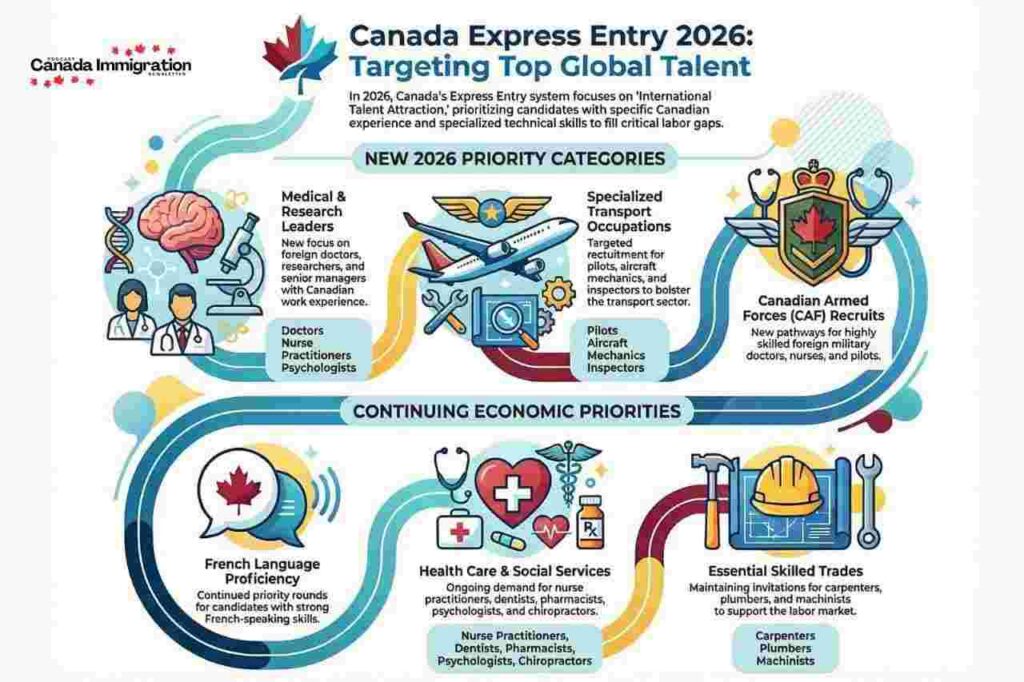
The latest reform prioritizes researchers and senior managers with Canadian experience, transport occupations, and skilled military personnel, while also increasing the minimum work experience requirement for all categories to 1 year within the past 3 years. Unlike earlier rules, this experience no longer needs to be continuous, a change that could help many skilled professionals qualify more easily.
Table of Contents
Why Express Entry Category Expansion Matters in 2026
Category-based selection has become the primary route for many skilled foreign workers hoping to receive invitations through Express Entry. Since April 2024, most general draws have focused on candidates with Canadian work experience or provincial nominations, making occupational categories a critical pathway for overseas applicants.
By expanding categories, Canada is clearly shifting toward labour-market-driven selection rather than purely CRS-based competition. Experts view this as a strategy to address workforce shortages while supporting broader national initiatives, including economic growth and defence priorities.
New Occupations Added Under Express Entry
The newly announced occupation groups include:
Senior Managers with Canadian Experience
The “Senior Managers with Canadian Experience” category in Express Entry is a category-based selection group introduced by Immigration, Refugees and Citizenship Canada (IRCC) to target high-level leaders who have already worked in Canada in top executive roles.
Researchers with Canadian Work Experience
The “Researchers with Canadian Work Experience” category in Express Entry is a category-based selection stream used by Immigration, Refugees and Citizenship Canada (IRCC) to invite candidates who have recent Canadian work experience in research-related occupations.
Skilled Military Recruits
The “Skilled Military Recruits” category in Express Entry is a category-based selection pathway introduced by IRCC to help Canada attract candidates who have the skills and experience needed for careers in the Canadian Armed Forces (CAF).
Applicants must meet additional criteria, including 10 years of continuous military service, a 3-year Canadian Armed Forces job offer, and a post-secondary credential of at least 2 years.
Transport Occupations
- Air pilots and flight engineers
- Automotive service technicians
- Aircraft mechanics and avionics specialists
Interestingly, this updated transport category replaces a previously retired version and includes entirely different occupations, reflecting updated labour priorities.
One-Year Work Experience Requirement: What Changes?
Another major adjustment is the increase in required work experience from 6 months to 1 full year. This experience must fall within the past 3 years but no longer needs to be continuous.
For applicants, this means:
- More flexibility in qualifying work periods
- Greater emphasis on verifiable skilled experience
- Increased competitiveness for category-based draws
How Category-Based Selection Shapes Express Entry
Category-based selection allows IRCC to issue Invitations to Apply (ITAs) only to candidates meeting specific occupational or language criteria. Since its launch in 2023, the system has issued over 144,000 ITAs across categories such as healthcare, trades, French-language proficiency, and STEM roles.
The government also confirmed continued prioritization of:
- French-language proficiency
- Health care and social services
- Trades occupations
Meanwhile, the agriculture and agri-food category has been retired.
What Applicants Should Do Now
For candidates planning their permanent residence strategy, these changes suggest several actions:
- Review whether your occupation aligns with the newly added categories
- Ensure at least 1 year of skilled work experience is documented
- Keep Express Entry profiles updated with current NOC codes
- Monitor upcoming draws including the first physician category draw expected soon
The Bigger Immigration Picture
Beyond workforce goals, these changes also align with Canada’s broader economic and defence strategies. By focusing invitations on targeted sectors, the government is balancing immigration growth with labour market realities.
At the same time, Minister Diab emphasized that asylum pathways should remain separate from skilled immigration routes, signalling ongoing reforms designed to keep immigration channels more structured and purpose-driven. Canada’s expansion of Express Entry categories marks a clear shift toward strategic, occupation-based immigration. By prioritizing senior managers, researchers, transport professionals, and skilled military candidates, the government is creating more direct routes for talent that aligns with long-term national goals. For applicants, adapting quickly to these evolving priorities may be the key to receiving an invitation in 2026 and beyond.